

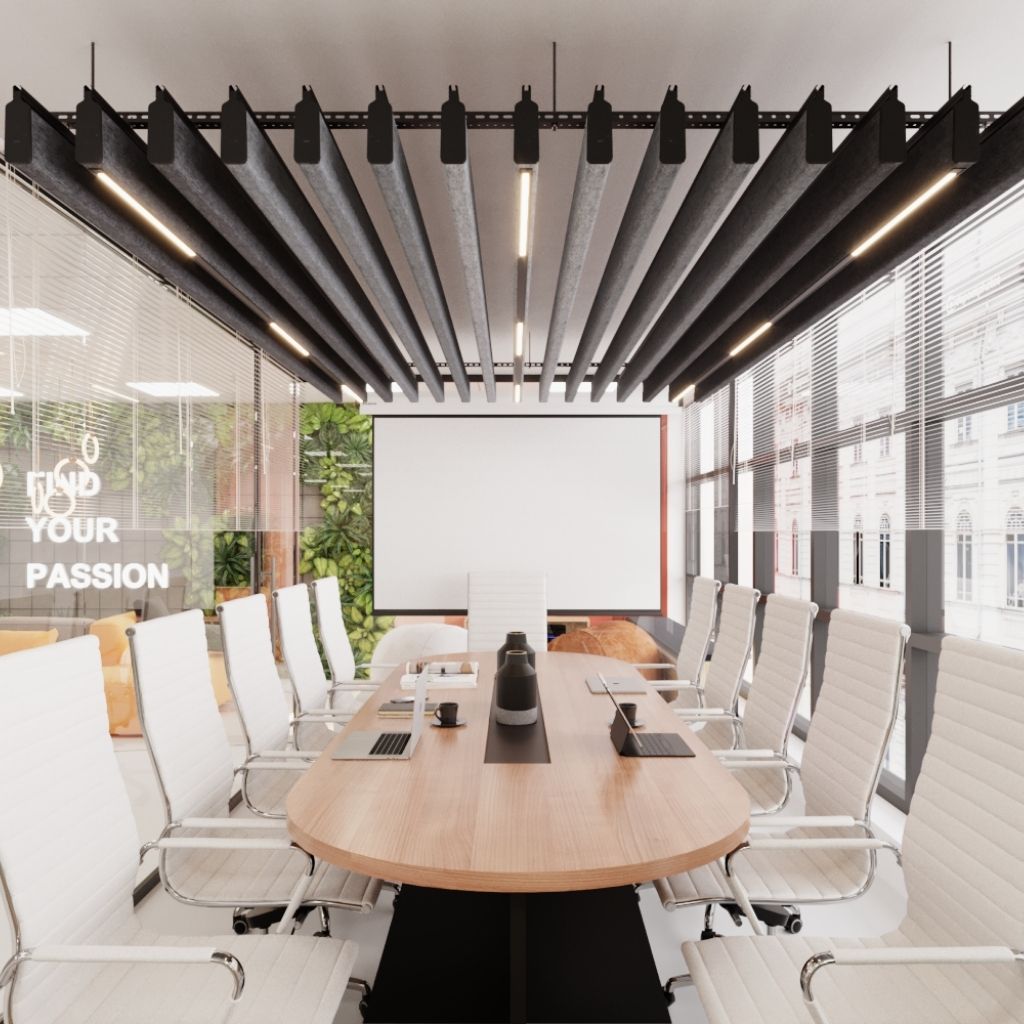
When wall space is limited and reverberation is out of control, ceiling baffles are the most efficient acoustic intervention available — absorbing sound in three dimensions while shaping the ceiling into a design feature.
01 What are acoustic ceiling baffles and how do they work?
Acoustic ceiling baffles are vertical felt or fabric panels suspended from the ceiling to intercept sound waves traveling through the upper volume of a room. Unlike wall panels that treat reflections at a single surface, baffles work three-dimensionally — absorbing sound on both faces and the exposed edges simultaneously — making them significantly more efficient per square foot of material.
Sound energy in a room follows the inverse square law: intensity decreases as it spreads, but reflective hard surfaces (glass, concrete, metal, gypsum) bounce it back, creating reverberation. In spaces with ceiling heights above 3 meters, the upper air volume acts as a reverberation reservoir. Baffles placed in this zone intercept early reflections before they compound into echo, reducing RT60 without any wall modifications.
The physics advantage over wall panels: a single baffle panel absorbs from two faces and its long edges, yielding an effective absorption area greater than its face dimensions. In practice, a 600mm × 1200mm baffle performs acoustically closer to a 1.8–2.0 m² wall panel when spaced at recommended intervals.
RT60 is the standard measure of reverberation: the time for sound to decay by 60dB. Offices target RT60 of 0.4–0.6s. Open spaces without treatment often measure 1.2–2.5s. A correctly specified baffle array can bring RT60 into the target range without structural changes.
02 AcousticMod baffle profiles: full series comparison
AcousticMod offers 12 baffle profiles across two performance tiers. NRC 0.75 models deliver higher absorption and suit spaces with severe reverberation. NRC 0.60 models balance acoustic performance with stronger visual presence — ideal where the ceiling is a primary design element.
NRC 0.75 — High Performance Series
NRC 0.60 — Design-Led Series
03 How to specify: coverage, spacing, and NRC targets
The starting point for baffle specification is the room's target RT60 value. For offices and meeting rooms, the WELL Building Standard recommends RT60 below 0.5s in enclosed spaces. To reach this from a typical untreated open-plan office (RT60 ~1.2s), baffles should cover 25–35% of the ceiling area, spaced at 300–600mm intervals.
Specification steps
- Calculate room volume (L × W × H in meters)
- Measure current or estimate baseline RT60 — use Sabine's formula for an initial estimate
- Set target RT60 for the space type (office: 0.4–0.6s · restaurant: 0.6–0.8s · lobby: 0.8–1.2s)
- Calculate required absorption units (sabins) to bridge the gap
- Select baffle profile based on NRC rating and available ceiling height
- Calculate panel count: divide required sabins by per-panel absorption area × NRC
- Distribute panels across ceiling evenly — clustering reduces diffusion effectiveness
Recommended coverage by space type
| Space type | Target RT60 | Recommended profile | Coverage |
|---|---|---|---|
| Open-plan office | 0.4–0.6s | Knife A/B, Slim C | 30–40% |
| Conference room | 0.4–0.5s | Knife B/C, Radius | 35–45% |
| Restaurant / café | 0.6–0.9s | Wave, Trapez | 20–30% |
| Hotel lobby | 0.8–1.2s | Radius, Slate | 15–25% |
| School classroom | 0.4–0.6s | Slim A/B, Knife C | 30–40% |
| Industrial / warehouse | 1.0–1.5s | U Baffle 100/150 | 20–35% |
04 Installation: suspension systems and ceiling height
AcousticMod baffles are suspended using steel cable or rod systems attached to the structural ceiling. Minimum recommended ceiling height for baffle installation is 3.2 meters — lower heights risk visual heaviness and restrict air handling. Standard drop from ceiling to baffle top: 100–200mm. Baffle length typically runs 1200–2400mm depending on the profile.
- Suspension method: aircraft-grade steel cable (standard) or threaded rod for heavier U Baffle systems
- Fixing interval: one suspension point per 600mm of baffle length minimum
- Ceiling structure: concrete slab, steel beam, or timber joist — drywall alone is insufficient
- Electrical coordination: plan baffle rows around lighting tracks and sprinkler positions before installation begins
- Installation sequence: mark ceiling grid → install suspension anchors → hang baffles → level and adjust
In projects where structural ceiling access is limited (e.g. raised access floors above), AcousticMod U Baffle systems can be surface-mounted to exposed structure using direct bracket attachment rather than cable suspension. Consult project specs for load ratings.
05 Design integration: color, rhythm, and ceiling zoning
Baffles are available in 4 standard colors — Black, Grey, Light Grey, and Dark Grey — and sold in 10-panel boxes. Mixed-color layouts allow ceiling zoning: darker tones recede visually and define focused work areas, while lighter tones reflect ambient light and suit open collaborative spaces.
Ceiling zoning with baffles follows the same spatial logic as furniture zoning on the floor plane. A single baffle profile in alternating colors creates rhythm without additional form complexity. In hospitality projects, designers frequently combine Wave or Radius profiles in 2–3 tone gradients to reference natural textures — water, stone, forest canopy — while maintaining full acoustic function.
For projects requiring LEED v4.1 EQ credits, AcousticMod baffles' NRC performance, fire classification (B-s1,d0), low-VOC certification, and ~50% recycled PET content support acoustic comfort prerequisites and materials credits simultaneously.
06 Maintenance and lifespan
PET felt baffles require minimal maintenance. Monthly vacuuming with a soft brush attachment removes airborne dust accumulation. Spot cleaning with a damp cloth handles localized marks. Professional dry cleaning is recommended every 3–5 years in high-footfall commercial environments.
Expected lifespan under normal commercial use: 10–15 years.
07 Frequently asked questions
Baffles are vertical panels suspended from the ceiling — they absorb sound on both faces and edges, making them efficient in high-volume spaces. Ceiling clouds are horizontal panels positioned parallel to the ceiling — they primarily address early ceiling reflections directly above a work area. Baffles outperform clouds in reverberant open spaces; clouds are more effective over focused workstations or meeting tables.
A standard rule of thumb: cover 25–35% of ceiling area with baffle material. For a 200 m² open-plan office with 4m ceilings, this typically means 60–80 standard baffles (1200mm × 300mm) distributed evenly across the ceiling grid. Your acoustic consultant can refine this with an RT60 calculation based on actual room finishes.
No. AcousticMod PET felt baffles are rated for indoor use only. Moisture exposure degrades the felt structure and reduces acoustic performance over time. For semi-outdoor covered spaces (covered terraces, atriums with roof openings), consult the project specifications for appropriate moisture-resistant alternatives.
Yes. AcousticMod baffles carry fire reaction class B-s1,d0 under EN 13501-1 — the standard required for most commercial interior applications in the US and EU. This classification means limited combustibility (B), very limited smoke production (s1), and no burning droplets (d0). Always verify project-specific fire codes with your AHJ.
Yes, with planning. Baffle rows must be coordinated with HVAC diffuser throw patterns and sprinkler coverage radii during the design phase. Baffles placed directly below diffusers can disrupt air distribution. Standard practice is to leave a 300–600mm clear zone around each diffuser and verify sprinkler coverage is unobstructed per NFPA 13.
Standard lead time is 1–3 business days from order confirmation. Baffles are packaged in boxes of 10 panels. For large commercial projects requiring 50+ boxes, contact the trade program team for project pricing and phased delivery scheduling.
Browse the full 12-profile baffle range, download spec sheets, or request a sample box to evaluate profile and color options before specification.

Share:
Which Is the Best Acoustic Panel?
AcousticMod in the new TV series “Doctor: Another Life”