

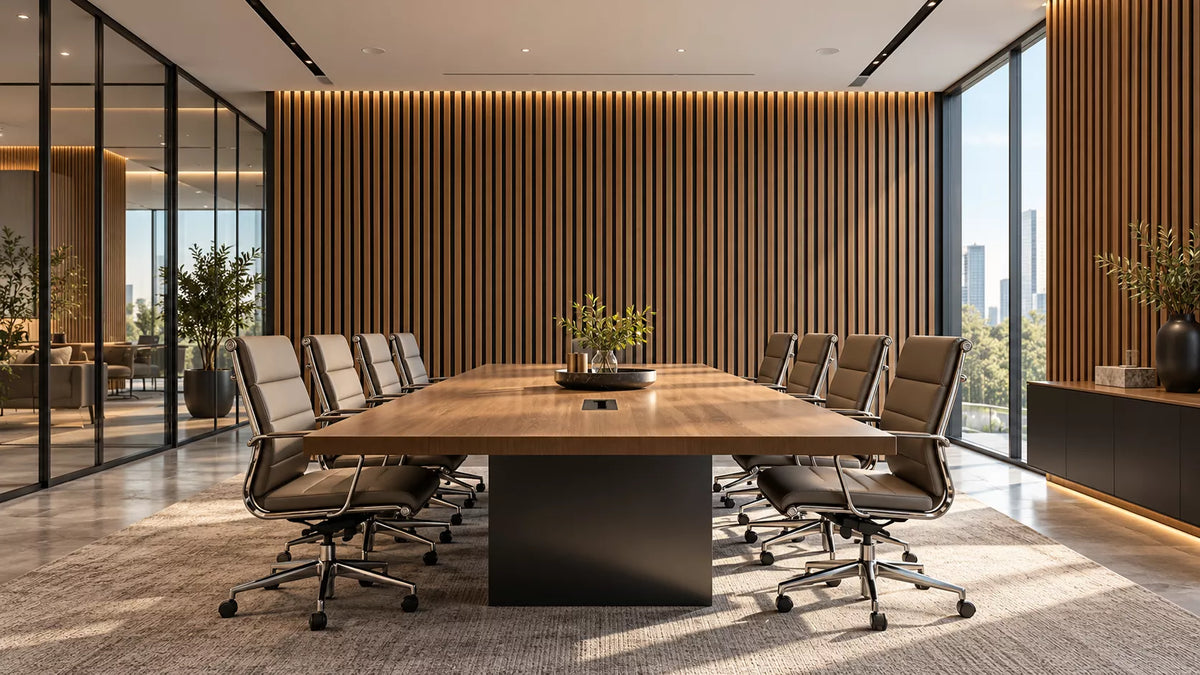
A conference room should make communication easier, not harder. Whether the space is used for executive meetings, client presentations, hybrid calls, training sessions, or daily team discussions, poor acoustics can quickly reduce speech clarity and make even a well-designed meeting room feel uncomfortable.
Modern conference rooms often include glass partitions, hard flooring, large displays, exposed ceilings, wood furniture, and minimal soft furnishings. Visually, these materials can create a clean and professional environment. Acoustically, however, they can reflect sound repeatedly throughout the room and contribute to echo, reverberation, and reduced speech intelligibility.
This is where conference room acoustic panels and properly planned acoustic ceiling systems become important. By introducing sound-absorbing surfaces in strategic locations, architects and workplace designers can create meeting spaces that support clearer communication while maintaining a refined architectural appearance.
At AcousticMod, we develop architectural acoustic solutions for offices, meeting rooms, conference spaces, and commercial interiors. From our Houston, Texas office and warehouse, we support architects, interior designers, contractors, developers, and commercial clients across the United States with wall and ceiling acoustic systems designed for both performance and visual integration.
Why Conference Room Acoustics Matter
A conference room is fundamentally a communication space. If people struggle to hear one another clearly, the room is not functioning as intended regardless of how sophisticated the furniture, technology, or lighting may be.
Poor acoustics can cause speech to overlap with reflections from walls, ceilings, floors, and glass surfaces. Instead of hearing only the direct sound from a speaker, listeners also hear delayed reflections returning from multiple directions.
These reflections can make speech sound less precise and can become especially noticeable during group discussions. When several people speak in sequence, the sound from one voice may remain active in the room long enough to interfere with the next.
Conference room acoustics therefore affect far more than comfort. They influence meeting efficiency, concentration, presentation quality, hybrid communication, and the professional impression created when clients or partners enter the space.
What Causes Echo in Conference Rooms?
Echo and excessive reverberation are usually created when a room contains too many reflective surfaces and too little absorptive material. Glass partitions, concrete, gypsum board, polished stone, metal, and hard furniture surfaces can all contribute to this problem.
Glass-walled meeting rooms are particularly common in modern offices because they provide openness, transparency, and daylight. However, large glass surfaces offer very little acoustic absorption and can create repeated reflections between parallel walls.
Hard ceilings can add another reflective plane. In rooms with exposed structure or minimal ceiling treatment, sound may travel upward before being reflected back toward occupants.
The solution is not necessarily to cover every surface. Effective conference room acoustic treatment focuses on identifying dominant reflective zones and introducing the right amount of absorption through wall panels, ceiling systems, acoustic felt products, or a coordinated combination of solutions.
How Conference Room Acoustic Panels Improve Speech Clarity
Acoustic panels absorb part of the sound energy that reaches their surface. This reduces the amount of sound that is reflected back into the room and helps create a more controlled acoustic environment.
In a conference room, this can improve speech clarity because spoken words reach listeners with fewer competing reflections. The goal is not to make the room acoustically dead, but to create enough control that voices remain distinct and understandable.
Wall-mounted acoustic treatment is often useful because speech energy frequently travels horizontally between occupants. Panels positioned on key reflective walls can help reduce strong lateral reflections that interfere with communication.
For conference rooms where wall space is limited, Acoustic Baffles or Hanging Ceiling Tiles can introduce acoustic absorption overhead while keeping screens, whiteboards, glass walls, and presentation surfaces unobstructed.
Best Acoustic Panels for Conference Rooms
There is no single acoustic panel that is ideal for every conference room. Product selection should reflect the architecture, room size, available surfaces, visual concept, ceiling conditions, and required acoustic performance.
Slat Wood Acoustic Panels are particularly suitable for executive meeting rooms, boardrooms, and client-facing spaces where acoustic treatment also needs to create a premium architectural finish.
PET felt wall panels provide greater flexibility in color, shape, and geometric composition. They can be used to create subtle acoustic surfaces or more expressive feature walls depending on the workplace design language.
For rooms with limited wall availability, ceiling-based products such as Acoustic Baffles, Hanging Ceiling Tiles, and Drop Ceiling Tiles can provide an effective alternative or complement to wall treatment.
Conference Room Acoustics for Video Conferencing
Hybrid meetings have made conference room acoustics even more important. Microphones used for Zoom, Microsoft Teams, Google Meet, and other conferencing platforms do not hear a room in exactly the same way as the human ear.
A microphone captures direct speech together with room reflections, HVAC noise, movement, and other background sound. In a highly reverberant conference room, these reflections can make remote participants hear speech as distant, hollow, or unclear.
Acoustic treatment can help improve the quality of the signal reaching conference-room microphones by reducing unnecessary reflected sound. This creates a cleaner acoustic environment before any digital noise reduction or processing is applied.
For video conferencing spaces, acoustic design should therefore be considered alongside microphone placement, speaker positioning, camera setup, and room layout. Technology performs best when the physical acoustic environment is already well controlled.
Glass-Walled Conference Rooms and Acoustic Challenges
Glass conference rooms are one of the most common acoustic challenges in contemporary workplace design. They create openness and visual connectivity but can also produce strong reflections because large glass surfaces absorb very little sound.
Parallel glass walls can create particularly noticeable reflection patterns. Speech can repeatedly bounce between surfaces, making the room feel more reverberant than its physical dimensions would suggest.
Where the glass itself must remain unobstructed, acoustic treatment can be introduced on adjacent solid walls, behind presentation areas, or above the room using suspended ceiling systems.
AcousticMod's wall and ceiling solutions allow designers to preserve the transparency of glass architecture while adding absorption in areas that do not interfere with the visual concept. Slat Wood Acoustic Panels can be used on feature walls, while ceiling baffles or hanging tiles provide another layer of acoustic control overhead.
Wall Panels vs. Ceiling Baffles in Meeting Rooms
Wall panels and ceiling baffles address the same general problem—excessive reflected sound—but their architectural roles are different. Wall systems are ideal when solid vertical surfaces are available and can be incorporated into the design.
Slat wood panels are especially effective when a conference room requires a visually warm and executive appearance. The wood finish contributes to the interior concept while the acoustic backing provides sound absorption.
Ceiling baffles become valuable when wall space is occupied by glazing, screens, writable surfaces, artwork, or branding. Suspended above the table, they introduce acoustic absorption without affecting the functional use of the walls.
Many meeting rooms benefit from combining both approaches. A slat wood wall behind the main presentation area can be paired with acoustic baffles above the conference table, creating a balanced system that manages reflections across both vertical and horizontal planes.
Acoustic Treatment for Large Boardrooms
Large boardrooms can be acoustically challenging because longer distances between speakers and listeners increase dependence on good speech clarity. Larger room volumes also allow sound to remain active for longer periods.
Long tables create additional complexity. People seated at opposite ends of a boardroom may already be several meters apart before room reflections are taken into account.
Acoustic absorption should therefore be distributed strategically rather than concentrated in a single corner. Wall surfaces, ceiling areas, and zones above or around the main table can all be evaluated.
For larger executive spaces, combining Architectural Wood Panels, PET felt systems, and suspended acoustic ceiling products can create a comprehensive architectural acoustic solution without making the room appear over-treated.
Acoustic Treatment Without Compromising Interior Design
One of the main concerns in executive and client-facing conference rooms is maintaining a premium visual identity. Acoustic products should not look like technical equipment added after the interior has already been completed.
Architectural acoustic products can instead become part of the design language. Slat wood systems can introduce warmth and rhythm, PET felt can create geometric forms, and suspended ceiling elements can define the visual zone above a conference table.
This makes acoustic treatment especially valuable during the early design stage. When acoustics are considered alongside lighting, furniture, AV systems, ceiling design, and material finishes, acoustic products can be incorporated intentionally.
AcousticMod's complete acoustic product collection is designed to support this approach by providing coordinated wall and ceiling systems for commercial interiors.
ASTM E84 Class A Performance for Commercial Meeting Spaces
Fire-performance documentation is an important part of commercial material specification. Architects, contractors, developers, and project managers often require supporting test data before acoustic products can be incorporated into workplace projects.
AcousticMod's independently tested PET acoustic felt meets ASTM E84 Class A surface burning criteria, supporting informed material selection for commercial interiors.
The tested PET acoustic felt achieved:
Flame Spread Index: 5 / Class A Limit: 25
Smoke Developed Index: 300 / Class A Limit: 450
Both results are within the relevant Class A criteria. These values provide project teams with measurable information that can be reviewed during the material selection and specification process.
ASTM E84 evaluates comparative surface-burning characteristics under controlled test conditions. It should not be interpreted as a complete fire-risk evaluation of every finished installation or assembly.
Architects, contractors, and project teams should always review the complete product documentation, applicable codes, local requirements, assembly conditions, and project-specific specifications.
AcousticMod technical and certification information can be reviewed through our Certificates page.
For information about the standard itself, architects and specifiers can also consult ASTM International.
Why Class A Performance Matters in Office Interiors
Office projects often include acoustic materials across substantial wall or ceiling areas. For this reason, surface-burning performance can become an important factor when selecting products for commercial environments.
Professional specification requires more than choosing a product because it looks appropriate. Project teams may need acoustic data, material information, fire-performance documentation, installation details, and supporting certificates.
AcousticMod's independently tested PET felt provides documented results rather than relying on generic fire-related claims. The reported Flame Spread Index of 5 is within the Class A maximum of 25.
The reported Smoke Developed Index of 300 is also within the Class A maximum of 450. This provides architects and contractors with specific data that can be evaluated as part of the project's broader code and specification requirements.
Acoustic Solutions for Small Meeting Rooms
Small conference rooms can still experience significant acoustic problems. In fact, close parallel walls and extensive glass can make reflections particularly noticeable even in compact spaces.
Because occupants sit close to walls, reflected speech may return very quickly after the direct sound. This can create a harsh or box-like acoustic character during meetings.
Small rooms do not necessarily require large quantities of material. Strategic treatment on one or two important surfaces, or a carefully positioned ceiling element, may provide a more efficient solution.
The objective should be to create acoustic balance without visually overcrowding the room. AcousticMod wall and ceiling products can be selected according to available space, interior design, and desired acoustic performance.
Acoustic Solutions for Open Office Meeting Rooms
Meeting rooms located within open-plan offices face a combination of internal and external acoustic challenges. The meeting room itself may have reflective surfaces, while surrounding office activity creates additional background noise.
Inside the room, acoustic panels help manage reverberation and speech reflections. However, it is important to distinguish this from sound isolation, which relates to how much sound passes through walls, doors, glazing, and other construction assemblies.
Acoustic treatment and sound isolation serve different purposes. Absorptive panels improve conditions inside the room, while partitions and construction details determine how effectively speech is contained between spaces.
For more general workplace acoustic planning, AcousticMod's product ecosystem can support both enclosed meeting rooms and surrounding open-office environments through coordinated wall and ceiling treatment.
Sustainable Acoustic Materials for Modern Workplaces
Sustainability has become an increasingly important consideration in workplace design. Many commercial projects now evaluate material composition, recycled content, durability, sourcing, and long-term usability alongside visual and acoustic performance.
PET felt can provide acoustic absorption while allowing recycled material to be incorporated into architectural wall and ceiling products.
AcousticMod uses recycled PET content across applicable felt-based product systems. This allows project teams to integrate acoustic performance while supporting more responsible material selection strategies.
Durability is equally important. Conference rooms and commercial offices are used repeatedly over many years, making long-term performance and visual resilience important parts of a sustainable design approach.
Why Choose AcousticMod for Conference Room Acoustic Projects?
AcousticMod develops architectural acoustic products for commercial interiors, including offices, conference rooms, boardrooms, hospitality environments, educational spaces, and other professional projects.
Our products include Slat Wood Acoustic Panels, acoustic ceiling baffles, hanging ceiling systems, PET felt products, architectural wood panels, and additional acoustic solutions designed for integration into modern interiors.
We work with architects, interior designers, contractors, developers, and workplace teams throughout the specification process. Technical data, material information, acoustic documentation, fire-performance documentation, and project consultation can be provided according to project needs.
Our objective is not simply to supply panels. We support project teams in selecting acoustic products that align with the architecture, functional requirements, ceiling conditions, visual concept, and technical specification of the space.
Houston Office & Warehouse: U.S.-Based Project Support
AcousticMod operates a U.S.-based office and warehouse in Houston, Texas, providing direct support for architects, designers, contractors, developers, facility managers, and commercial clients across the United States.
Our Houston operation provides a U.S. point of contact for project consultation, product questions, technical documentation, samples, quotations, commercial orders, and project coordination.
AcousticMod Houston Office & Warehouse
Address
17939 Kieth Harrow Blvd, Suite 101
Houston, TX 77084
United States
Email
info@acousticmod.com
Phone
+1 346-575-3132
Business Hours
Monday – Friday
09:00 – 17:00
Our Houston warehouse also supports fulfillment for eligible products and commercial orders throughout the United States. Project requirements can be coordinated according to quantity, product type, technical specification, shipping destination, and project schedule.
For Texas-based architects and contractors, our Houston location also provides a direct regional connection to the AcousticMod team.
Frequently Asked Questions About Conference Room Acoustics
1. Do acoustic panels help reduce echo in conference rooms?
Yes. Acoustic panels absorb reflected sound energy, helping reduce excessive reverberation and improve speech clarity inside a conference room.
2. Where should acoustic panels be placed in a meeting room?
Common locations include walls opposite speakers, side walls, areas behind seating, and ceilings above the conference table. The ideal placement depends on room dimensions, surface materials, furniture layout, and available treatment areas.
3. Are acoustic panels useful for video conferencing?
Yes. Reducing excessive reflections can create a cleaner acoustic environment for microphones, helping improve the quality of speech captured during video conferences.
4. What is the best acoustic panel for a boardroom?
The best solution depends on the architecture. Slat Wood Acoustic Panels are suitable for executive feature walls, while PET felt products and ceiling baffles can provide greater flexibility in rooms with limited wall space.
5. Do acoustic panels soundproof a conference room?
No. Acoustic panels primarily control reverberation and reflected sound inside the room. Soundproofing or sound isolation requires appropriate walls, doors, glazing, seals, and construction assemblies.
6. Are AcousticMod PET acoustic materials Class A?
Yes. AcousticMod's independently tested PET acoustic felt meets ASTM E84 Class A surface burning criteria. The tested material achieved a Flame Spread Index of 5 / 25 and a Smoke Developed Index of 300 / 450.
7. Are ceiling baffles suitable for meeting rooms?
Yes. Ceiling baffles are especially useful where wall space is occupied by glazing, displays, presentation boards, or other architectural elements. They can be positioned above conference tables to introduce acoustic absorption.
8. How many acoustic panels does a conference room need?
The amount depends on room dimensions, ceiling height, surface materials, panel performance, layout, and acoustic objectives. A project-specific evaluation is more reliable than selecting a fixed number based only on room area.
9. Does AcousticMod support conference room projects across the United States?
Yes. AcousticMod operates from its Houston, Texas office and warehouse and supports commercial acoustic projects throughout the United States.
10. Can AcousticMod help architects specify acoustic products for office projects?
Yes. AcousticMod supports architects, interior designers, contractors, developers, and commercial project teams with acoustic product guidance, technical documentation, fire-performance information, material data, and project consultation.
Improve Conference Room Acoustics With AcousticMod
A well-designed conference room should support communication from the moment a meeting begins. Clear speech, controlled reverberation, balanced sound, and professional architectural design should work together rather than compete.
Whether your project requires Slat Wood Acoustic Panels, PET felt wall systems, Acoustic Ceiling Baffles, Hanging Ceiling Tiles, or a combination of wall and ceiling treatment, AcousticMod can help you identify the appropriate architectural acoustic solution.
Our independently tested PET acoustic felt meets ASTM E84 Class A surface burning criteria, with a Flame Spread Index of 5 and a Smoke Developed Index of 300.
With a U.S.-based Houston office and warehouse, AcousticMod provides direct support for architects, interior designers, contractors, workplace consultants, developers, and commercial clients throughout the United States.
Contact AcousticMod
Houston Office & Warehouse
17939 Kieth Harrow Blvd, Suite 101
Houston, TX 77084, United States
Email: info@acousticmod.com
Phone: +1 346-575-3132
Hours: Monday – Friday, 09:00 – 17:00
Planning a new conference room, executive boardroom, or office renovation?
Request a Project Quote or explore the AcousticMod product collection to find architectural acoustic solutions for your workplace project.

Share:
Restaurant Acoustic Panels: How to Reduce Noise Without Compromising Interior Design
Acoustic Panels for Offices: A Complete Guide to Better Workplace Acoustics